Bhai Tika being observed across Nepal today; auspicious hour set for 11:07 am

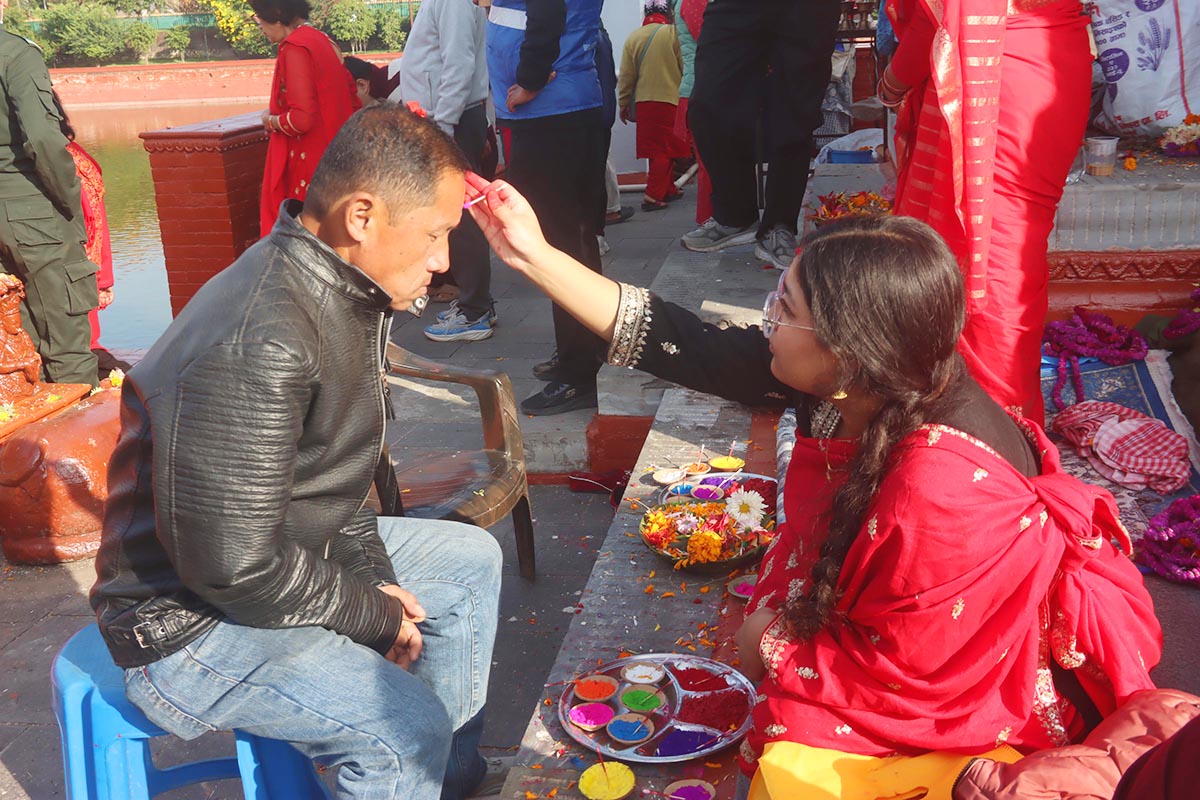
KATHMANDU: Bhai Tika, the main festival of Tihar, is being observed across Nepal today. Nepal Panchanga Nirnayak Bikash Samiti (NPNS) has set 11:07 am as the most auspicious time for applying tika.
Although tika may be applied throughout the day, Purushottam Bhattarai, chairperson of the NPNS, said that 11:07 am is the most auspicious time for those wishing to observe a specific auspicious moment. He said there is no restriction on applying tika at other times during the day.
NPNS has advised that sisters applying the tika should face east while brothers receiving it should face west. According to NPNS, this alignment places the moon, which enters the Scorpio zodiac sign today, on the right side during the ritual.
Scripture expert Ramchandra Gautam said the same directional arrangement may be followed even when the moon is in Libra. According to him, scriptural tradition holds that the moon should be in front of or to the right during auspicious rites.
Observed annually on Kartik Shukla Dwitiya, Bhai Tika is considered the principal festival of Tihar and is also known as Yamadwitiya. Sisters apply either a seven-coloured or five-coloured tika to their brothers and offer flower garlands and gifts, while brothers present their sisters with clothes and monetary gifts according to their means.
During Bhai Tika, sisters worship the oil lamp, water vessel and Lord Ganesha established on Laxmi Puja before offering prayers to the eight immortals: Markandeya, Ashwatthama, Bali, Vyasa, Hanuman, Vibhishana, Kripacharya and Parashurama. Worship is also offered to Chitragupta, Yamaraj, Yamuna, Dharmaraj and other deities represented in an eight-petalled lotus design.
The ritual includes circling brothers with a stream of oil, applying the traditional tika and adorning them with flower garlands made of globe amaranth, marigold and chrysanthemum.
Gautam said that while the use of a seven-coloured tika has become widespread, scriptural tradition prescribes five colours: red, white, yellow, green and blue.
After the ceremony, sisters traditionally present their brothers with walnuts, chestnuts, spices and festive foods including sel roti.
The Balgopaleshwar Temple, located in the centre of Ranipokhari in Kathmandu, opens only once each year on Bhai Tika for people without brothers or sisters and serves as a place of worship where devotees can offer prayers and receive tika.
Kathmandu Metropolitan City spokesperson Nabin Manandhar said that preparations had been completed to open the temple for devotees from early Wednesday morning.
Guthi Sansthan Chairperson and culture expert Govinda Tandan said people without siblings also have a tradition of worshipping and receiving tika at Khanjaneshwor Mahadev Temple in Jayabageshwari.
According to Tandan, devotees gathered at the Jayabageshwari temple before 2035 BS (1978 AD), when access to Balgopaleshwar Temple was restricted because people attempted to enter the temple by jumping into Ranipokhari. He said large numbers of worshippers still visit Khanjaneshwor Mahadev Temple on Bhai Tika.
Tandan said Balgopaleshwar Temple began opening regularly after 2035 BS. Following damage caused by the earthquake in 2015, devotees without siblings continued visiting Khanjaneshwor Mahadev Temple until 2077 BS (2020 AD). The reconstructed Balgopaleshwar Temple has been open to devotees since 2077 BS.
The Newar community observes the occasion as Kija Puja. According to family traditions, some households performed the ritual today, while others observed it on the previous day. Most of the Newar community in Bhaktapur reportedly celebrated Kija Puja yesterday in accordance with a decision by priests and astrologers of the local Taleju Temple.
(With inputs from RSS)